Multiphase Flow in Porous Media
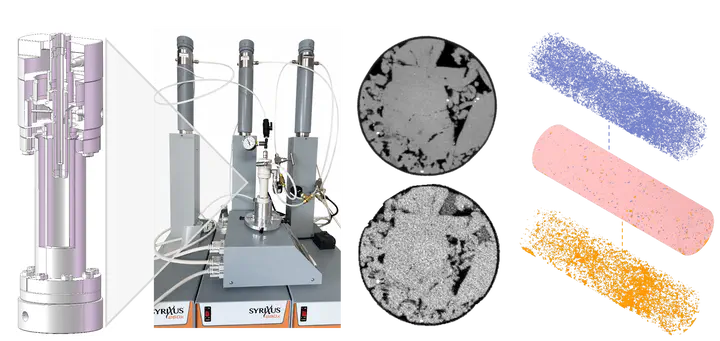
Multiphase flow through porous media governs critical processes in subsurface energy, carbon and hydrogen storage, groundwater systems, and resource recovery. Yet commonly used continuum-scale descriptions rely on empirical closure laws that do not explicitly account for pore architecture, fluid-interface dynamics, or deformation of the solid skeleton.
Supported by an ACS Petroleum Research Fund New Doctoral Investigator award, GIL is investigating how solid deformation reshapes pore-scale multiphase flow and transport. A central focus is the Haines jump—a rapid interface-rearrangement event that occurs when a nonwetting fluid abruptly invades a pore body. The research integrates microfluidics experiments with a deformation-enabled Lattice Boltzmann solver to resolve how changes in pore geometry affect invasion thresholds, jump dynamics, phase connectivity, fluid trapping, and transport.
Deformation-coupled Haines jump dynamics
Microfluidic devices provide controlled, optically accessible pore networks in which deformation, injection conditions, wettability, and pore geometry can be varied systematically. High-resolution experiments will be paired with Lattice Boltzmann simulations that explicitly represent moving fluid interfaces and deformation of pore boundaries. Direct comparison between experiments and simulations will enable model validation and reveal the coupled mechanisms governing Haines jumps in deformable porous materials.
From pore structure to multiphase behavior
A complementary research thrust will quantify relationships between pore-network statistics and emergent multiphase-flow behavior through an integrated workflow:
CT imaging → pore-network statistics → statistically controlled pore-network generation → 3D printing → experiments and simulations
CT scans will be used to characterize pore-size distributions, throat-size distributions, coordination, connectivity, tortuosity, and spatial correlations. These descriptors will guide the generation and 3D printing of controlled pore networks, allowing experiments and simulations to isolate how individual statistics—and combinations of statistics—govern displacement patterns, capillary instabilities, phase connectivity, and trapping.
Predictive closure laws
The ultimate goal is to develop physically informed closure laws that express continuum-scale multiphase behavior in terms of measurable pore-scale parameters and deformation state. Target relationships include:
- Capillary pressure–saturation behavior,
- Relative permeability,
- Residual phase saturation, and
- Deformation-dependent trapping and transport.
These closure laws will provide a pathway from pore-scale mechanisms and statistical structure to predictive reservoir- and continuum-scale models.

Yanbo Bai
PhD Student in Petroleum Engineering
I am a Ph.D. student in Petroleum Engineering at Texas A&M University, focused on fundamental investigations of electrowetting, electroosmosis, and electromigration in porous and fractured geomaterials. My research integrates customized microfluidic platforms and electrically controlled core-flooding experiments with in situ micro-CT characterization to elucidate coupled electro-hydro-mechanical-chemical processes. These efforts target applications in mineral in situ mining, electrically enhanced oil recovery (EEOR), and critical mineral recovery from shale formations. Prior to joining Texas A&M, my research centered on microwave-assisted hard rock drilling technologies. This work encompassed multiphysics field modeling, multiscale mechanical property characterization, and upscaling analyses, as well as studies of rockburst tendency and damage distribution in hard rock subjected to microwave-induced fracturing.

Anu Tiwari
BS Student in Petroleum Engineering
I am a B.S. student in Petroleum Engineering at Texas A&M University. My interests include reservoir engineering, pore-scale imaging, and data-driven modeling for petroleum applications. I am currently involved in undergraduate research using micro-CT to analyze multiphase flow in porous reservoir rocks, developing reproducible Python/PoreSpy workflows for image processing, segmentation, and pore-structure quantification with relevance to reservoir flow and EOR.