Induced Seismicity
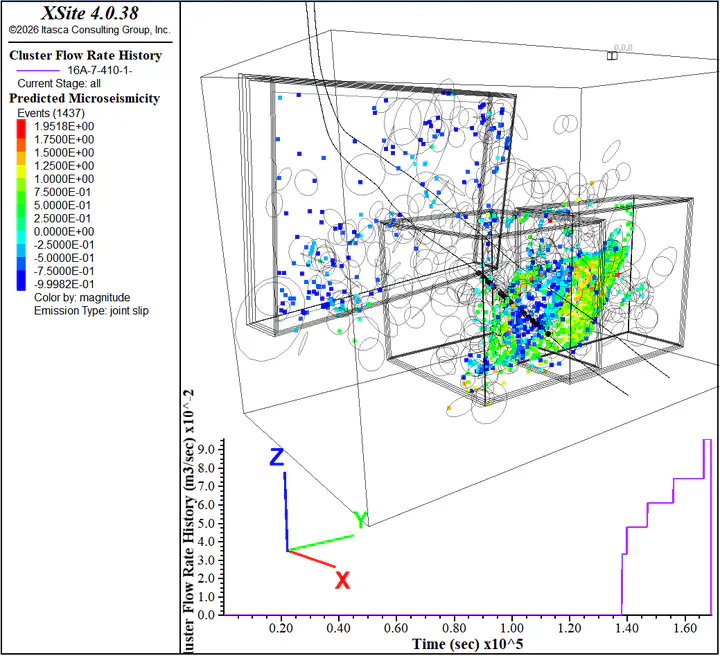
It is well known that fluid injection (e.g., CO₂ sequestration, waterflooding, or subsurface stimulation) can induce seismic events. The mechanisms for injection-time seismicity are relatively well established, typically attributed to either effective stress reduction due to elevated pore pressure or increased total stress that reactivates pre-existing fractures. However, a significant portion of induced seismic events, particularly those with larger magnitudes, occur after injection has ceased. The mechanisms driving these post-injection events remain poorly understood. Our laboratory is actively investigating this knowledge gap using advanced numerical modeling tools.
Related publications
- Cardenas-Acevedo, N., Si, X., Dai, S., Peng, Z., Williams, J., & Jin, W. (2026). Modeling Microseismicity in Enhanced Geothermal Systems: Impacts of Injection Parameters at Utah FORGE. In Proceedings, 51st Workshop on Geothermal Reservoir Engineering, Stanford University, Stanford, California.

Nicolas Cardenas Acevedo
PhD Student in Petroleum Engineering
Ph.D. student in Petroleum Engineering at Texas A&M University specializing in reservoir geomechanics, geothermal energy, and induced seismicity modeling. His research experience spans compressed-air energy storage and the development of nanomaterials for enhanced oil recovery and drilling fluids. He advances sustainable energy solutions through geomechanical analysis, numerical modeling, and innovative problem-solving. As a Research Assistant for the Utah FORGE project, he focuses on large-scale numerical simulation and microseismic data analysis.