Hydraulic fracturing
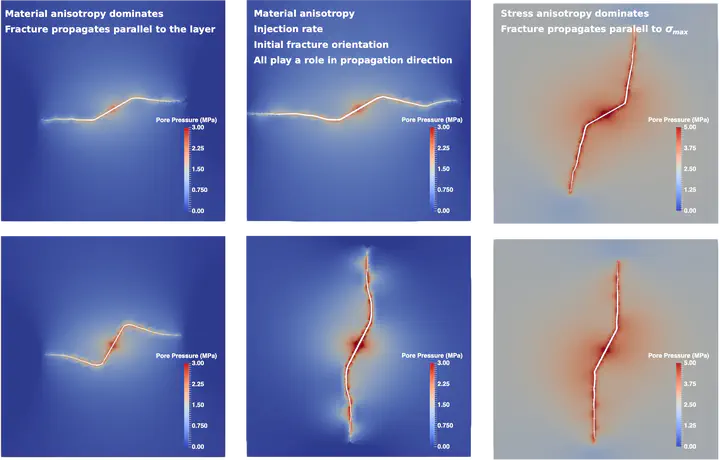
Hydraulic fracturing has revolutionized the oil and gas industry, and decades of field practice have enabled a deep understanding of many aspects of the process. However, several key phenomena remain insufficiently addressed:
- The conventional mode-I fracture propagation mechanism does not explain the observed generation of fracture swarms;
- Modeling of fracture growth coupled with proppant transport and settlement requires significant improvement;
- Fracture closure during shut-in and flowback periods—and the resulting residual fracture aperture—are still not well characterized.
Beyond the inherent complexity of these multiphysics processes, achieving high-fidelity modeling of hydraulic fracturing demands extensive computational resources. Our group is developing advanced computational tools, incorporating refined physical mechanisms and GPU-accelerated simulations, to tackle these challenges.
Related publications
- W. Jin, C. Arson, (2019). Fluid-driven transition from damage to fracture in anisotropic porous media: a multi-scale XFEM approach. Acta Geotechnica, 15(1), 113-144.
- Jin, W., Zhao, C., Pham, V. V., Yang, M., Egert, R., McLing, T., … & Villamor-Lora, R. (2025, June). ELK: a MOOSE framework based computational tool for modeling electro-hydraulic fracturing. In ARMA US Rock Mechanics/Geomechanics Symposium (p. D021S009R002). ARMA.
- Egert, R., Fournier, A., & Jin, W. (2026). Modeling proppant transport and settling in a 3D propagating fracture. Deep Underground Science and Engineering.
- Amirov, R., Meehan, D. N., & Jin, W. (2026). Lattice-Beam Modeling of Mixed-Mode Fracture: Benchmarking 3-Point-Bending with Asymmetric Notch. In ARMA US Rock Mechanics/Geomechanics Symposium (p. D022S041R005). ARMA.

Rasul Amirov
PhD Student in Petroleum Engineering
Ph.D. student in Petroleum Engineering at Texas A&M University specializing in reservoir geomechanics and hydraulic-fracturing simulation. I develop GPU/CUDA-accelerated, high-performance lattice-method solvers to model coupled Mode I/II/III fracture initiation and propagation in heterogeneous formations, including fracture-swarm behavior. Prior work includes deep learning for EOR, petrophysical characterization, and time-series well-production forecasting. My goal is to translate fracture mechanics into design insights that reduce costs and enhance recovery.
Jerrick Xie
BS Student in Petroleum Engineering
BS student in Petroleum Engineering at Texas A&M University interested in geomechanics and finite element methods.