Dynamic Stimulation Technologies
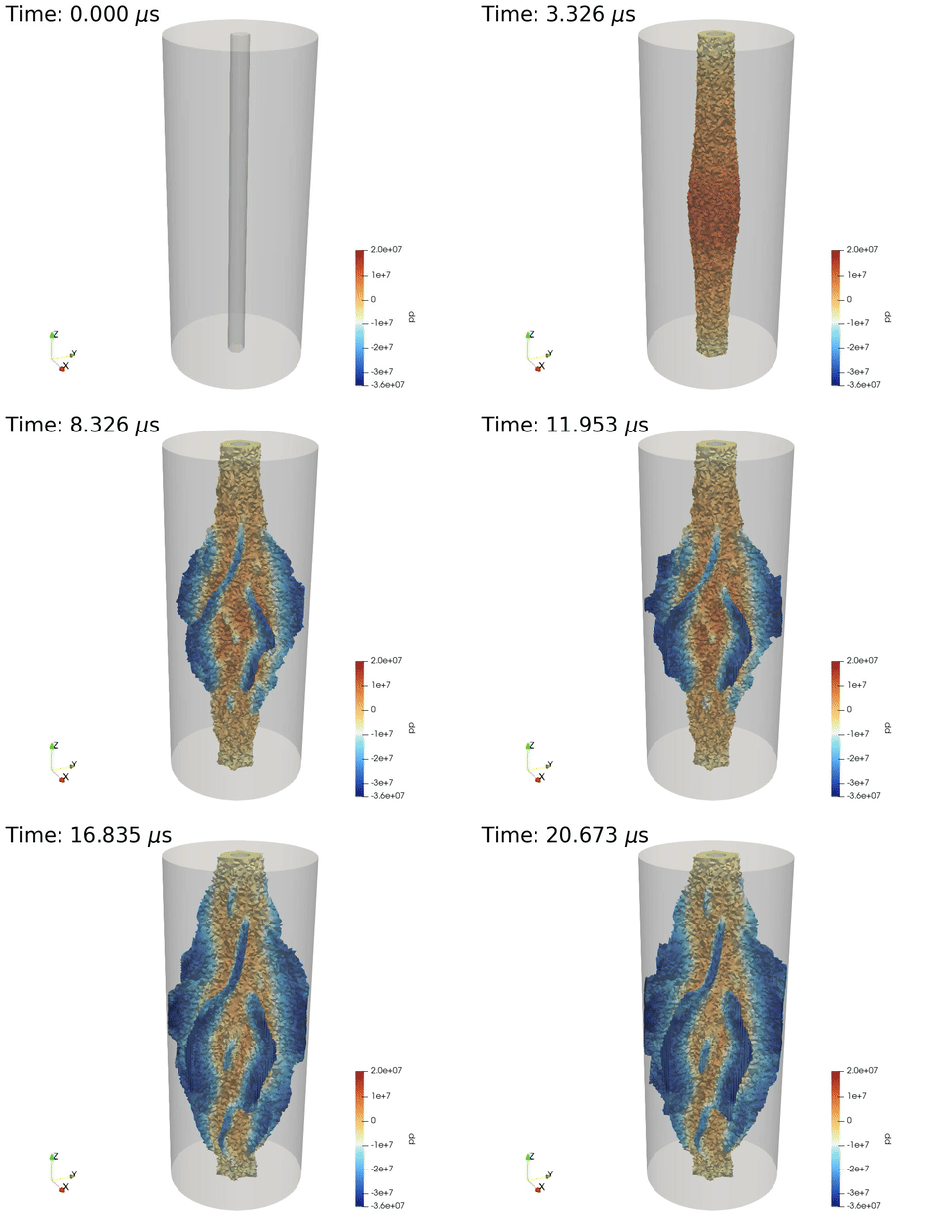
Conventional hydraulic fracturing applies fluid pressure quasi-statically, which often constrains fracture propagation to the direction of minimum in situ stress. Dynamic stimulation technologies instead deliver energy over short timescales, activating stress waves, inertia, rapid fluid–solid interaction, and other transient effects that can promote mixed-mode fracture growth, branching, and distributed fracture networks.
GIL develops experimental and computational frameworks to understand and predict these coupled high-rate processes. The goal is to create stimulation strategies that mitigate short-circuiting, enhance permeability, and expand geochemical reaction surfaces for applications including in-situ mining, geothermal energy extraction, and geologic hydrogen production.
Pulsed-power and electro-hydraulic fracturing
An important current focus is pulsed-power and electro-hydraulic fracturing, in which rapid electrical energy release generates pressure pulses and stress waves in dry or fluid-saturated rock. Our models couple solid deformation, fluid flow, evolving damage, and dynamic fracture propagation to determine how loading rate, saturation, and material heterogeneity control fracture-network development.
Related publications
- Zhao, C., Elbanna, A., Villamor-Lora, R., & Jin, W. (2026). A fully coupled hydro-mechanical phase-field framework for dynamic pulsed-power fracturing in fluid-saturated rocks. Computer Methods in Applied Mechanics and Engineering, 461, 119197.
- Zhao, C., Elbanna, A., Villamor-Lora, R., & Jin, W. (2026). A Dynamic Continuum Phase-Field Framework for Electro-Hydraulic Pulse-Power Fracturing. In Proceedings, 51st Workshop on Geothermal Reservoir Engineering, Stanford University, Stanford, California.
- Jin, W., Zhao, C., Pham, V. V., Yang, M., Egert, R., McLing, T., … & Villamor-Lora, R. (2025, June). ELK: a MOOSE framework based computational tool for modeling electro-hydraulic fracturing. In ARMA US Rock Mechanics/Geomechanics Symposium (p. D021S009R002). ARMA.

Wencheng Jin
Assistant Professor of Petroleum Engineering
My research interests include novel rock breakage and fracture for subsurface resource recovery, data-driven and physics-based multiphysics modeling in porous and fractured media, and granular material flow characterization and modeling. My research supports energy and mineral recovery and storage, material handling, and geohazard prediction.